
Polyurethane Explained.
By Olmeck Editorial Team · Updated 2026-07-20
Polyurethane… What’s That?
You’ve probably touched, walked on, driven over, or even lived beneath polyurethane today without realizing it. Yet despite being one of the world’s most widely used materials, many people, “including those in construction, couldn’t explain what it actually is.”
So, what’s that?
What Exactly Is Polyurethane?
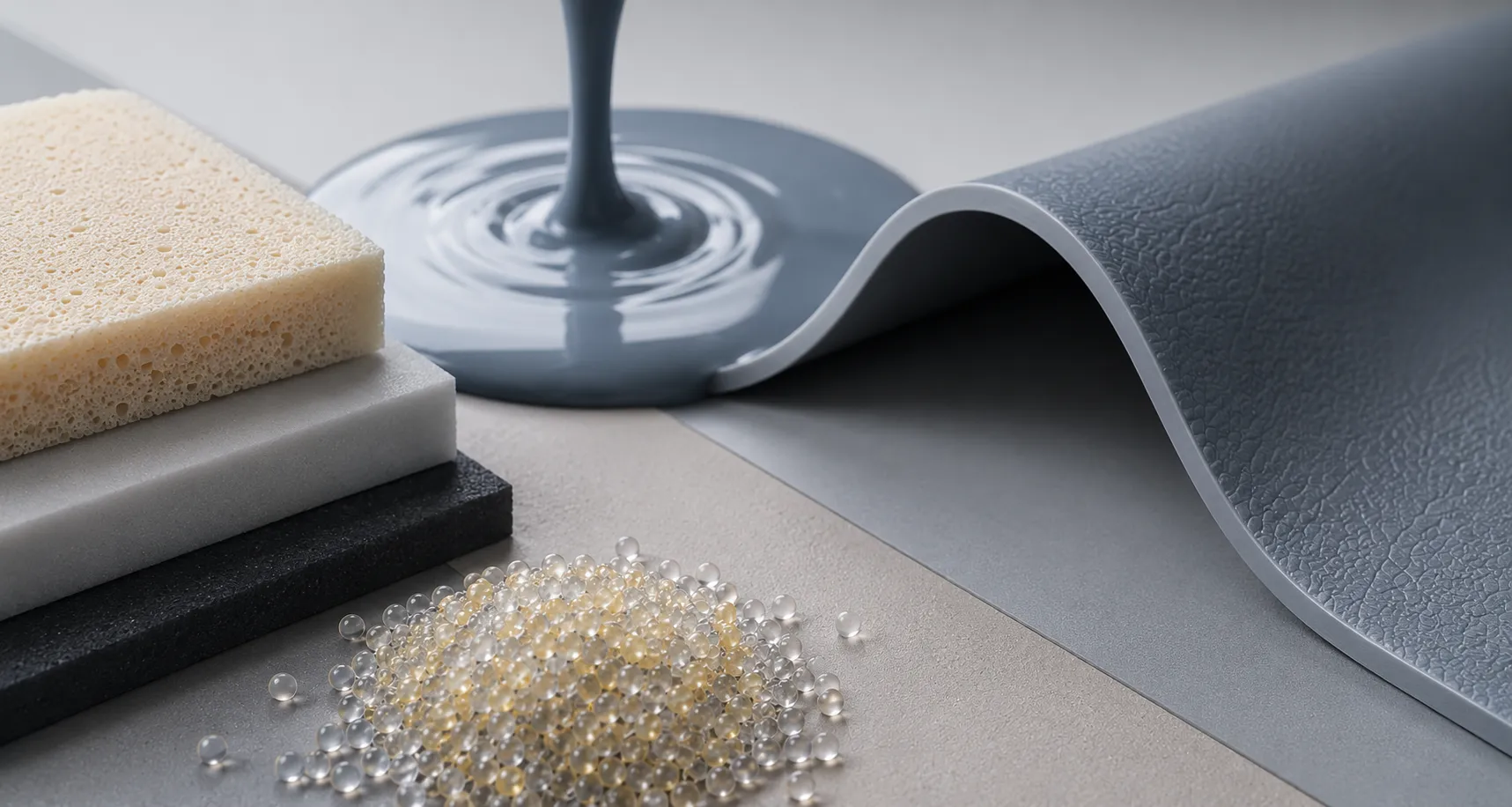
Polyurethane isn’t one specific material; it’s an entire family of engineered materials. By adjusting its chemical formulation, it can be made soft like a cushion, rigid like insulation, flexible like a waterproof membrane, or tough enough to withstand heavy industrial traffic.
That versatility is what makes polyurethane one of the most widely used materials in modern manufacturing and construction.
Whether it’s protecting a commercial roof, insulating a building, or adding comfort to a mattress, the science behind it is the same.
How Does Polyurethane Work?
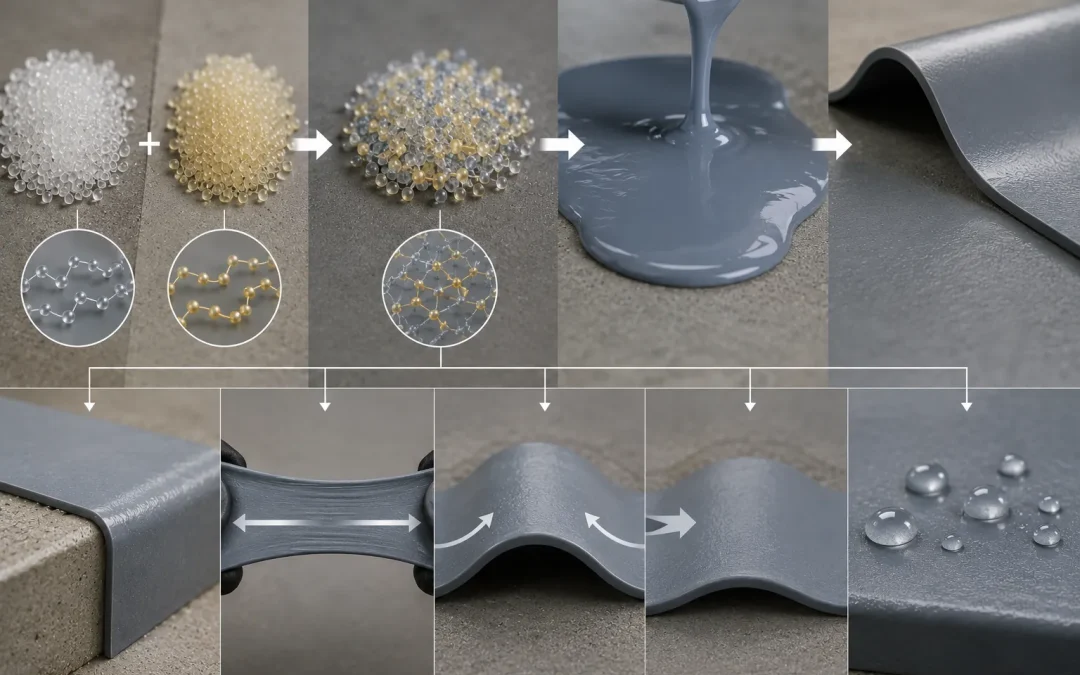
Polyurethane begins as two liquid components. When they’re mixed together, a chemical reaction starts almost immediately.
As the material cures, those components bond together to form a continuous three-dimensional molecular network. Instead of remaining a liquid, the material transforms into a solid with carefully engineered properties.
By changing the chemistry of that network, manufacturers can create products that are rigid, flexible, lightweight, impact-resistant, or highly durable. All from the same polyurethane technology.
Why Can Polyurethane Stretch Without Breaking?
Unlike brittle materials that crack under movement, polyurethane is designed to move.
Its molecular structure contains flexible chains connected by strong chemical bonds. When a roof, balcony, or parking deck expands and contracts with temperature changes, those chains can stretch and absorb the movement without the material tearing apart. Once the stress is removed, the material naturally returns toward its original shape.
That’s one of the main reasons polyurethane performs so well in waterproofing and roofing systems, where constant movement is expected throughout a building’s life.
Why does polyurethane outperform conventional roofing materials?
Polyurethane chemistry produces a seamless, monolithic membrane that conventional built-up roofing and single-ply sheets cannot replicate. Traditional materials rely on overlapping seams and mechanical fasteners — the exact failure points where leaks begin.
Olmeck’s Lava 20 polyurethane membrane cures fast, delivers high elasticity, and resists both tearing and impact. Those properties matter on apartment roofs, where standing water and thermal movement stress every weak point daily.
What makes a liquid-applied polyurethane membrane different from sheet roofing?
Olmeck’s liquid polyurethane products are never porous. Once hardened, the coating forms a single monolithic barrier with no seams, laps, or joints. The structural vulnerabilities that cause pooling water to penetrate conventional systems. Sheet membranes, by contrast, depend entirely on the integrity of every edge bond.
How long does a polyurethane roof system actually last?
Olmeck engineers its polyurethane systems to add 25 years to the life of a roof, backing that performance with industry-leading 25-year commercial warranties. cite-2 Polyurethane chemistry also adapts to challenging substrate geometries. Parapet walls, penetrations, irregular shapes — where rigid materials fail to maintain full contact.
Key performance advantages at a glance:
-
Fast cure time — minimizes project downtime
-
High elasticity — accommodates structural movement without cracking
-
Superior tear and impact resistance — withstands foot traffic and debris
-
Non-porous monolithic barrier — eliminates seam-related leak risk
Fast cure time — minimizes project downtime
High elasticity — accommodates structural movement without cracking
Superior tear and impact resistance — withstands foot traffic and debris
Non-porous monolithic barrier — eliminates seam-related leak risk
FAQ
What is polyurethane?
Polyurethane is a class of polymers composed of organic units joined by carbamate (urethane) links, produced through the cross-linking reaction of polyols with diisocyanates.
Why does polyurethane work across so many applications?
The wide variety of starting material combinations produces polymers with fundamentally different chemical structures, yielding rigid foams, flexible foams, coatings, and adhesives. cite-1
How does a liquid-applied polyurethane membrane differ from sheet roofing?
It cures into a single monolithic barrier with no seams, laps, or joints. Eliminating the structural vulnerabilities that cause pooling water to penetrate conventional sheet membrane systems.